
Dionysos: a game-changing solver for control systems
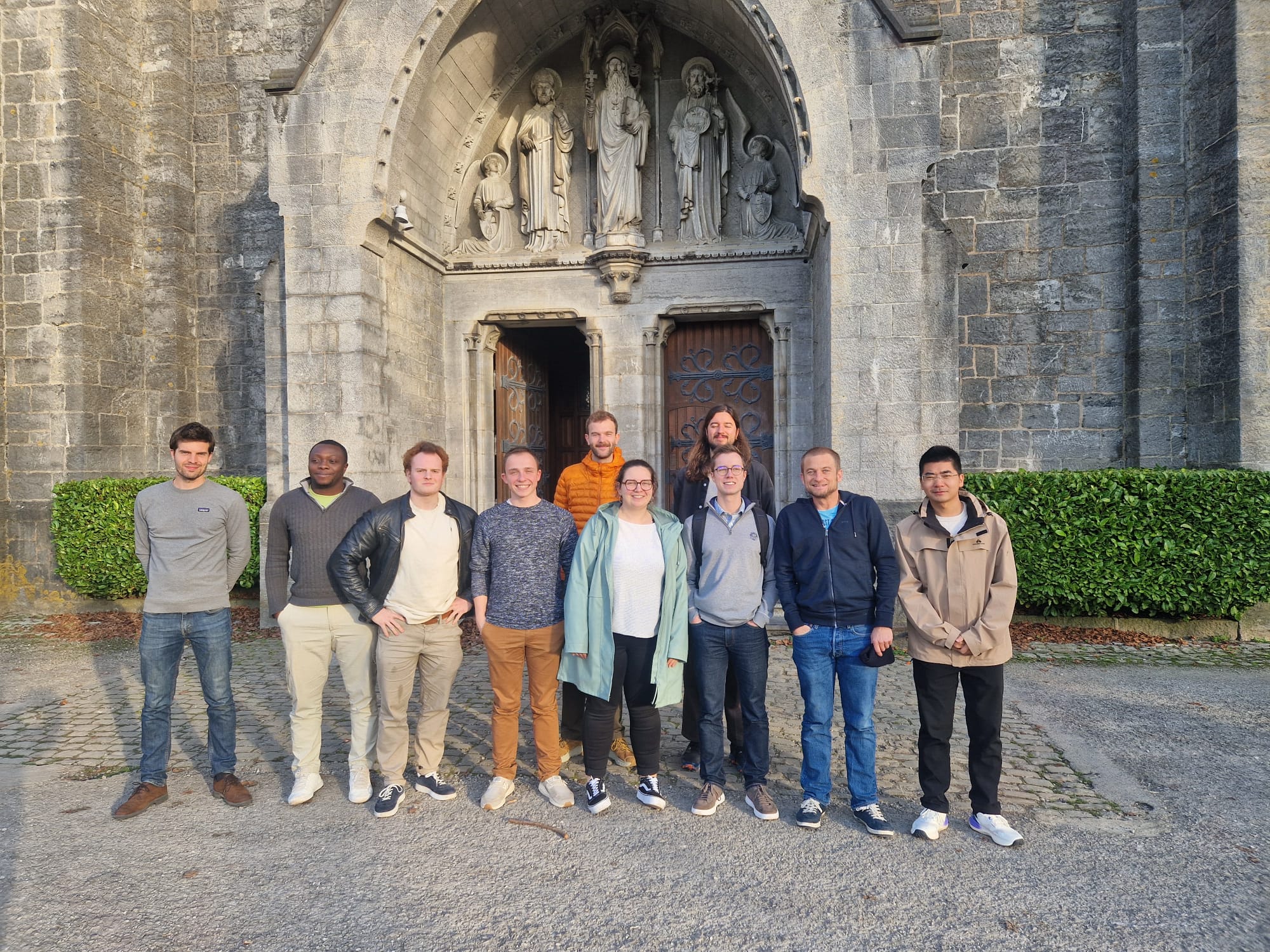
Prof Raphaël Jungers and Benoit Legat, along with their team, have developed Dionysos, a groundbreaking solver for control systems that transforms complex cyber-physical system challenges into simpler combinatorial problems using abstraction-based symbolic modeling, offering a flexible and efficient solution to manage increasing system complexity.
Consider the thermostat in your home heating system—it's a simple yet effective control system. It measures the room temperature, compares it to your desired setting, and adjusts the heating accordingly. This is just one example of how control systems ensure the smooth operation of modern technology, from industrial automation to autonomous vehicles. However, as cyber-physical systems (CPS) become increasingly complex, traditional control methods struggle to keep pace. For instance, autonomous vehicles must process vast amounts of data from sensors, cameras, and GPS systems in real-time to navigate safely and efficiently.
 is a cutting-edge solver developed within the ERC project Learning to Control (L2C). It’s the combined effort of several researchers led by professors Raphaël Jungers and Benoît Legat from ICTEAM/INMA (Mathematical Engineering).
Dionysos addresses the challenge of managing complex CPS by transforming continuous control problems into simpler combinatorial problems using a method known as abstraction-based symbolic modeling. It leverages  (Julia for Mathematical Programming), developed by Benoît Legat and others, along with advanced mathematical systems to define control problems intuitively. Its modular framework allows researchers to experiment with various abstraction techniques, such as uniform and ellipsoid grid algorithms—the latter recently introduced thanks to Julien Calbert's research—making it a highly flexible tool. By structuring control problems in this way, Dionysos provides an efficient way of managing the increasing complexity of CPS.
Abstraction-based symbolic modeling, while powerful, comes with its own set of challenges that open avenues for future research. One of the main challenges lies in balancing computational efficiency and accuracy—simplifying a system while preserving its essential dynamics is a complex mathematical task. Moreover, as cyber-physical systems become more complex, developing scalable abstraction methods that can handle high-dimensional spaces without excessive computational costs remains a pressing issue. The researchers are now working on refining these abstraction techniques and expanding Dionysos’s capabilities to address even more complex control scenarios.
Related Resources
Dionysos is the Julia software of the ERC project Learning to control (L2C). The current version is still in the making, and allows to solve problems such as reachability problems for hybrid systems.