
Low-Rank Techniques for Exoplanet Detection in High-Contrast Images
Exoplanets are planets orbiting stars outside our solar system and are difficult to detect due to their faintness and the bright light of host stars. Traditional detection methods struggle to isolate planetary signals from noise. A team led by Professors Pierre-Antoine Absil, Laurent Jacques, and Nicolas Gillis, along with Dr. Hazan Daglayan Sevim, developed a low-rank approximation approach that utilizes sparse modeling and matrix completion to improve the separation of planetary signals from background noise. This method enhances signal-to-noise ratios, aiding in identifying hidden exoplanets, though it also presents new computational challenges related to accuracy and adaptability across different telescopes.
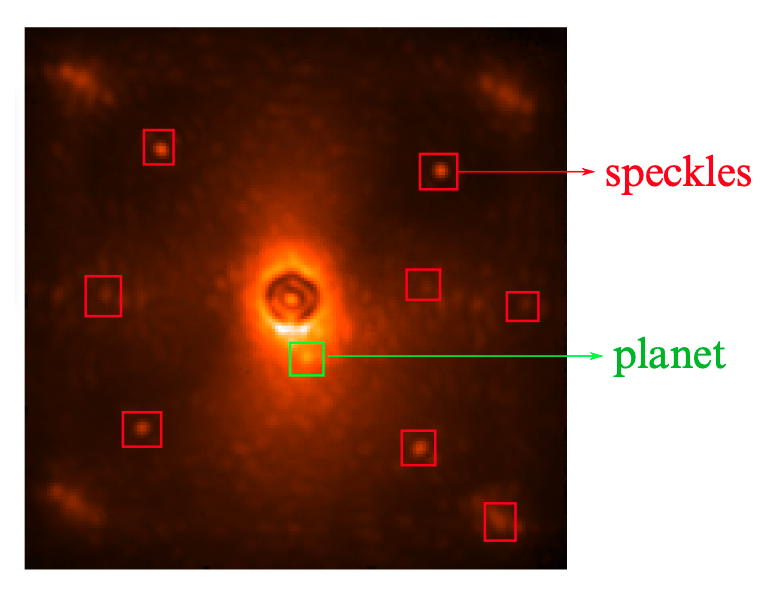
Exoplanets are planets that orbit stars outside our solar system. They differ from the planets in our own solar system mainly because of the vast distances that separate them from us and their tendency to be obscured by the bright light of their host stars. Unlike the planets within our solar system, which can be directly observed, exoplanets are much fainter, making them extremely difficult to detect. As illustrated in the image above, the intense light from the star dominates the scene. To differentiate an exoplanet from surrounding light artifacts—residual effects from the star—scientists must use advanced techniques to isolate actual planetary signals from noise. Professor Pierre-Antoine Absil from UClouvain and Nicolas Gillis from Umons have taken on this challenge together.
In her PhD thesis, Hazan Daglayan Sevim has illuminated this cosmic darkness by developing a low-rank approximation approach, which efficiently separates planetary signals from background noise. Unlike traditional methods, this technique uses sparse modeling and matrix completion, allowing for more precise detection even in the presence of overwhelming stellar light. This breakthrough significantly improves signal-to-noise ratios, enhancing our ability to identify hidden planets. By combining expertise in mathematical modeling, signal processing, and astrophysics, the team has created a powerful tool for future exoplanet discoveries.
While this new approach has notable advantages, it also introduces new computational challenges. Balancing accuracy and efficiency is crucial, as refining planetary signals without losing essential data is a complex task. Additionally, adapting these methods to different telescope datasets requires further refinement to ensure consistent performance under varying observational conditions.