
Mapping the Limits: A Breakthrough in Understanding the Stiefel Manifold’s Geometry
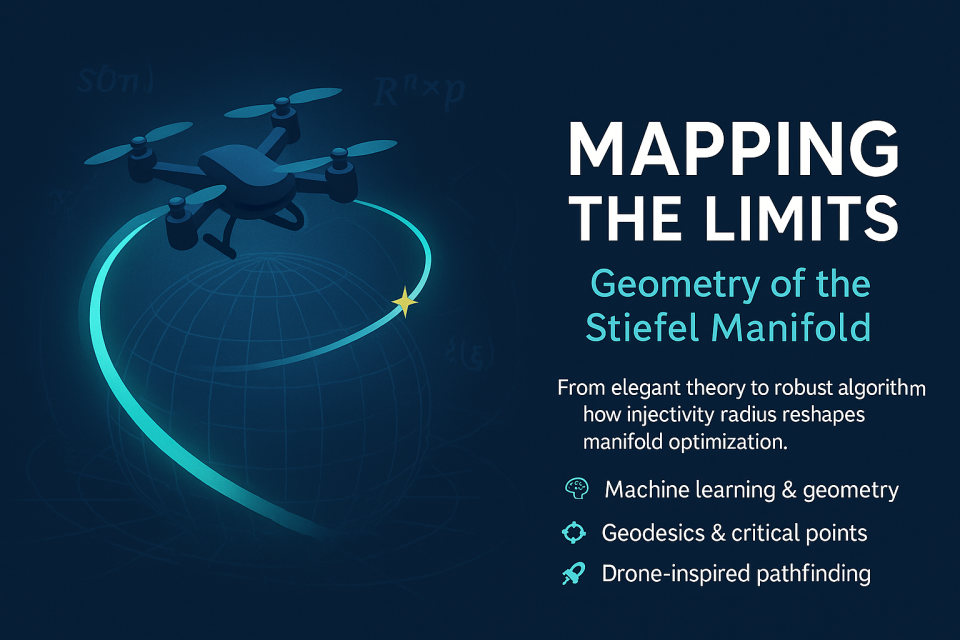
What do drone navigation, shape analysis, and AI algorithms have in common? They all rely on computing optimal paths in curved geometric spaces. Among these, the Stiefel manifold—a mathematical space representing sets of orthonormal frames—plays a key role. Despite its importance, a crucial geometric quantity known as the injectivity radius had remained elusive—until now. Researchers from UCLouvain have cracked this problem, offering new insights that bridge deep theoretical geometry and real-world optimization methods.
Imagine navigating a drone through 3D space—banking, rolling, and twisting with precision. Each maneuver involves complex rotations governed by mathematical structures known as manifolds. Among these, the Stiefel manifold stands out, as it represents all possible sets of orthonormal frames. This concept is essential in fields like robotics, computer vision, and machine learning. However, to navigate these curved spaces accurately, you need to understand how far you can travel along a straight path—called a geodesic—before complications arise. This distance is known as the injectivity radius, a fundamental yet elusive geometric quantity that ensures your path is indeed the shortest.
Despite the Stiefel manifold's significance, its injectivity radius has remained a mystery. This issue is particularly challenging due to the manifold's complex geometry and the difficulties associated with determining where geodesics cease to be optimal. This gap in knowledge poses challenges in optimization, statistics, and data fitting tasks that depend on accurate distance calculations. Prof. P.-A. Absil and his Ph.D. Student Simon Mataigne from UCLouvain's ICTEAM Institute, founded by the FNRS, embarked on this longstanding challenge.
Their work represents a significant breakthrough in the field. By identifying conjugate points—locations where shortest geodesics are no longer unique and/or cease to be minimal—across a broad range of Riemannian metrics, including the well-known canonical and Euclidean cases, they established an upper bound on the injectivity radius. Furthermore, they went beyond theory; through carefully designed numerical experiments, they demonstrated that their upper bound is likely precise. This offers new certainty for both theorists and practitioners. Their findings have a direct impact on manifold optimization methods, which leads to more robust algorithms for solving real-world problems such as sensor alignment, shape analysis, and multi-agent consensus.
The researchers’ findings pave the way for further exploration — formally proving the conjecture in all cases and extending similar analyses to other complex manifolds. As optimization and machine learning continue to evolve towards geometric and structure-aware methods, such foundational results ensure these algorithms remain accurate and reliable. Ultimately, their work bridges deep mathematical theory and practical computational needs — mapping the unseen limits that guide how we compute in curved spaces.